Postcard from Vittalina
Grey BeesThe postcards sent by Vitalina and Angelica are delayed family messages that Sergey Sergeyich turns into a fragile bridge across estrangement and the wartime isolation of his village. Their greetings arrive months late, yet their dates, handwriting, and shared signatures make them evidence of continuing connection; in response, Sergeyich composes a card for International Women’s Day, only to find that sending it will require help beyond the village.
Arrival and delayed greetings
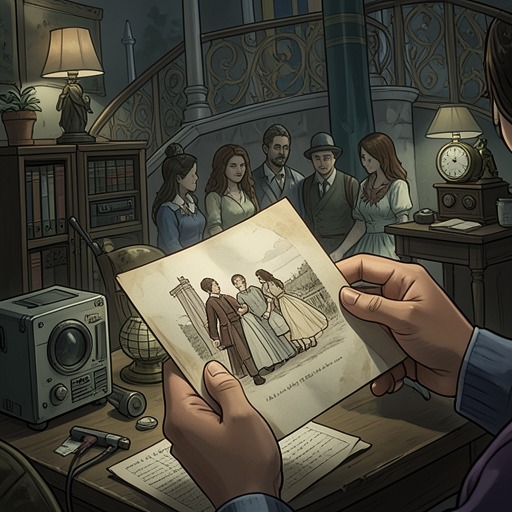
After returning from his unexpected postal duties, Sergey Sergeyich finds the day darkening and prepares buckwheat. The letters he had carried in his jacket remind him of the performance required to collect them from Pashka: he had jumped up and down like an idiot. He lights two church candles to join a third already burning in a jar, draws the flickering light closer, and opens the first envelope.
Inside is a New Year’s card addressed to dear Sergey, wishing him wisdom, health, and peace, and hoping peace will come soon. It is signed by Vitalina and Angelica. The message’s wishes are ordinary and intimate, but the circumstances of its arrival make them painful: Sergeyich recalls the lonely New Year’s Eve he spent waiting for midnight, drinking a glass of honey vodka, and going to bed. The card was postmarked Vinnytsia on December 16, 2015, long before he could read it.
Two more envelopes deepen the sense of a correspondence arriving out of time. One bears a Vinnytsia cancellation dated February 12, 2016; the third is also from the previous year, with a December postmark. One contains a 2016 Defender of the Fatherland Day greeting. The other offers fresh New Year’s wishes—health and happiness—and tells him to come to them if anything happens. The invitation makes him wonder what, exactly, might happen, but he can find no answer. The cards speak across distance without explaining how that distance might be crossed.
Handwriting and family resemblance
When Sergeyich later sits down at his table, he carefully rereads all three postcards. Their messages contain few words, so he studies the handwriting instead. The tenderness he feels surprises him; he attributes it partly to loneliness and partly to the fact that Vitalina, his ex-wife, has not forgotten him after three years of war and has signed the cards on behalf of their daughter as well.
The handwriting gives each card a distinct physical presence. Vitalina’s writing on the oldest card is even, rounded, and feminine, unlike Sergeyich’s unruly letters, which seem to escape their lines—first jutting upward, then sloping down like the field beyond his garden. On the Defender of the Fatherland card, Vitalina’s letters are squat and lean to the right, as though she had written in haste. Sergeyich wonders whether the power might have gone out and forced her to write by candlelight, but the cards do not confirm that possibility.
The third card initially resembles the first, yet something in the signature catches his attention. On the first two, Vitalina has signed for both herself and their daughter. On the latest New Year’s card, Angelica has written her own name. Looking more closely, Sergeyich notices differences between his daughter’s handwriting and her mother’s, as well as a resemblance: their capital As are equally small, while their Es are entirely different. The discovery delights him. The postcards have become a means of seeing kinship not only in faces but in the shapes of letters.
From receiving to answering
Sergeyich props the three cards against the candle jar with their messages facing outward, then glances at them as he eats lunch. Their place in the room makes the family’s words part of his daily surroundings rather than something he reads once and puts away. The cards also prompt a change in direction: instead of remaining only their recipient, he decides to write to Vitalina. International Women’s Day, March 8, is approaching, and he wants to congratulate her and make clear that he has not disappeared and is still alive.
The question of how to address the card exposes the delicate shape of his separation from Vitalina. Sergeyich considers calling her esteemed and writing a separate message to Angelica as dear, since their daughter has nothing to do with the conflict between her parents. He rejects the plan because separate greetings would make it appear that he was dividing mother and daughter in his mind. His own understanding is that when the family split, it became two parts, not three—and that the parts may one day be put back together.
That possibility excites him enough to make him circle the table twice. Rereading Vitalina’s latest card, he finds the solution in the two names at the end. He begins his own greeting with “Dear Vitalina and Angelica,” then adds “My” at the start. The choice answers the problem of address by treating mother and daughter as the two parts of a family he still imagines reunited, rather than as separate recipients between whom he must choose.
A message caught in the grey zone
With no suitable blank postcard among his papers, Sergeyich copies the short greeting onto the back of a photograph. He writes his name on the envelope and adds his new postal address, 37 Shevchenko Street. He grins at the thought that Vitalina might assume he has moved only one street over. The address gives the message a practical destination while leaving room for the intimate fiction of proximity.
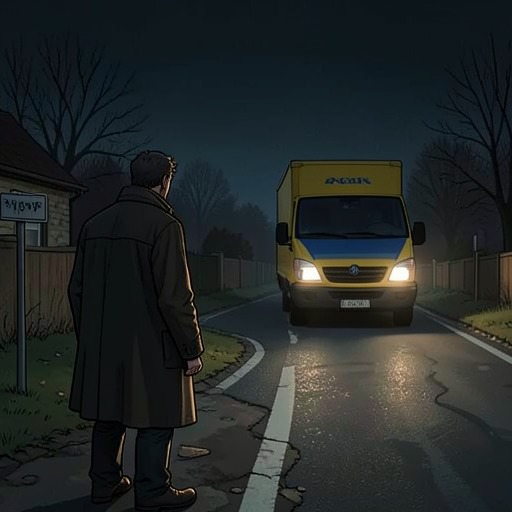
But the sealed envelope remains on the table until early evening. It lacks a stamp, and, more decisively, the village has no postal service: the Ukrposhta van has gone to Svitle and never returned. Its route had entered the grey zone and exited on the other side, apparently in one direction. Sergeyich recognizes that the driver and companion might have taken the envelope for him if he had asked and paid, but the thought had not occurred to him when they were there. Without them, he has to find another way to get the card to the mainland, where post offices work and stamps are sold.
The word “mainland” comes to him from an old film about Soviet polar explorers. In his present circumstances, it names a place that seems close—the direction beyond the ridge and horizon—yet remains separated from the village by a landscape caught between armed horizons. Sergeyich reflects that the grey zone is nearly deserted and that opposing forces shoot through it at one another; if both horizons disappeared, the zone could become mainland again. The postal problem thus turns a simple greeting into a measure of wartime disconnection: the family’s message reached him, but his answer cannot follow by ordinary means. He thinks of asking Petro to post the envelope, leaving the attempted reply poised between private hope and the village’s broken connection to the outside world.